Tablero de Jesús
Sympkyn of the Moor
Number of players: 2
Type of game: Dice / Gambling
Period: Period-esq (1971)
Tablero de Jesús is a gambling game for two players, played with two dice, a seven by seven board and a stake of coins. The players take turns moving coins up and down the columns of the board, trying to line up two or more coins side by side so they can take them. For many years it was played in the SCA as a 15th century Spanish game, but it is now known to be a modern invention. It is still a well loved game, especially in its drinking form, Tablero da Gucci.
History of Tablero de Jesús
The Story: The game came with a backstory claiming it was very popular in Spain and the Spanish Low Countries in the first half of the 15th century, and that it was banned by the Pope in 1458.
The Truth: No evidence of the game exists before about 1971. The period backstory appears to have been invented along with the game, and it was innocently picked up by the SCA in the 1970s as a period game.
New York Magazine: A piece in New York Magazine in December 1971 described Tablero as a modern invention, and the magazine carried an advertisement selling the game in 1972.
Toblaro and Tablero da Gucci: The drinking version, played with shot glasses in place of coins, has spread widely in the SCA and is especially popular in An Tir. It has also been sold as “Toblaro”, claimed to be an ancient Scottish drinking game.
Rules of Tablero de Jesús
Setup
Board: A 7×7 board. Rows 1 and 7 are the players’ home rows, one on each side.
Dice: Two six-sided dice.
Stakes: Each player puts up a stake of 15 coins.
Placing Coins: Each player rolls a die, rerolling ties. The low roller places five coins on their home row and the high roller places two coins on theirs, with no more than one coin in any column. This leaves exactly one coin in each of the seven columns.
First Player: The low roller plays first.
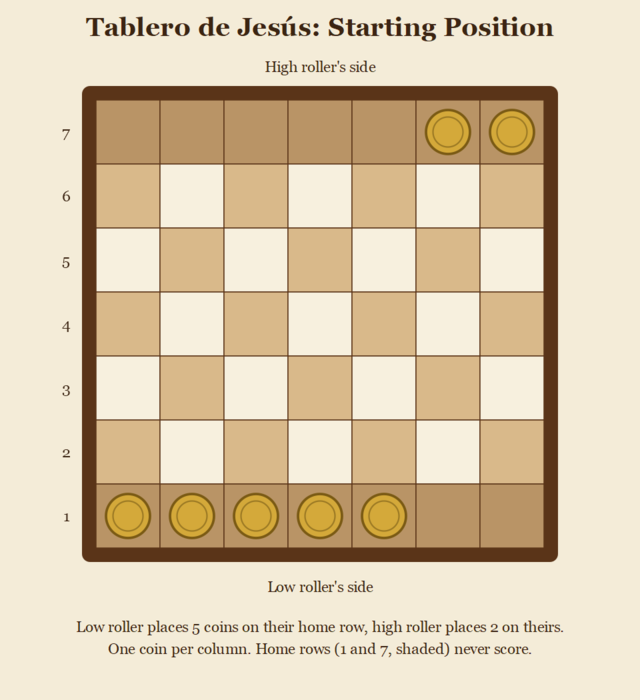
Tablero de Jesús Starting Position
Objective
- Line up two or more coins side by side in the same row so you can take them, and finish with the most coins.
Gameplay
Throw: Throw both dice. On a 7, 11 or 12 you lose the dice to your opponent without moving.
Move: On any other throw you must move two different coins, one for each die. Coins belong to no one, so you may move any coin on the board.
Columns Only: A coin moves up or down its own column by the number on the die, never across or diagonally. It may not go back and forth to use up a die.
Blocked: If you cannot use both dice, you move neither coin and lose the dice to your opponent.
Taking Coins: After moving, if two or more coins sit side by side in the same row (but not on row 1 or row 7), you may take them.
Refilling: When you take coins, your opponent refills the empty columns from their own stake and then takes the dice.
Receiving the Dice: A player who receives the dice must throw them at least once.
The Run
If you make a row of all seven coins, you may announce a run. Your opponent must stake two coins on it.
Throw the dice. On a 7, 11 or 12 you lose the run and your opponent takes all nine coins.
Otherwise you win the two coin stake, and may choose to run again.
The run ends when you lose a throw, your opponent cannot stake two more coins, or you decide to stop and take the seven coins.
Victory Conditions
The game ends when a player cannot refill the empty columns from their stake.
The winner is the player with the most coins when the game is over.
Optional and House Rules
1. Tablero da Gucci (Toblaro)
- Replace the coins with shot glasses. When you take glasses, you drink their contents, and your opponent refills them from their own bottle.
Summary Table
| Phase | Action |
|---|---|
| Setup | 15 coin stake each. Low roller places 5 coins on their home row, high roller 2 on theirs, one per column. |
| Movement | Throw two dice. 7, 11 or 12 loses the dice. Otherwise move two different coins up or down their columns, one per die. |
| Taking | Two or more coins side by side in a row (not a home row) are taken. The opponent refills the columns and takes the dice. |
| Run | A full row of seven lets you run for your opponent’s two coin stakes until you throw 7, 11 or 12 or stop. |
| Victory | Game ends when a player cannot refill. Most coins wins. |