Nard
Sympkyn of the Moor
Number of players: 2
Type of game: Dice / Tables
Period: 6th Century
Nard (also called Nardshir) is the Persian ancestor of backgammon and of the whole family of tables games. It is played on the familiar board of 24 points with 15 men each and two dice. The players move in opposite directions, hitting lone men and blocking each other, as they race to bring their men home and bear them off. David Parlett has called it “proto-Backgammon”.
History of Nard
The Name: The name comes from the Middle Persian nēw-ardaxšīr, “brave Ardashir”, linking the game with Ardashir I, founder of the Sasanian dynasty of Persia in the 3rd century.
Early Mentions: The oldest known mention of the game may be in the Babylonian Talmud, though scholars disagree over whether it means Nard or a Greek dice game. The Persian Book of the Deeds of Ardashir praises Ardashir’s skill at it.
The Invention Story: A Middle Persian text, the Chatrang-namak, tells how an Indian king sent the game of chess to King Khosrow I of Persia as a challenge. The wise vizier Bozorgmehr worked out how chess was played, and in reply invented Nard and sent it back to India, where no one could solve it. The same story is retold in Ferdowsi’s Shahnameh of about 1000 AD.
Meaning: The Persian texts give the game a cosmic meaning. The four quarters of the board stand for the four elements, the two dice for the turning of the heavens, and the players’ movements for the struggle between good and evil in Zoroastrian belief. Later writers add that the 30 men stand for the days of the month.
Spread: Nard spread through the Islamic world and on to Europe, where it developed into the medieval tables games. It is still played across the Caucasus and the former Soviet Union as nardi or Long Nardy, though with quite different rules.
Rules Source: The rules below follow the reconstruction of the early Persian rules given on Wikipedia and ancientgames.org.
Rules of Nard
Setup
Board: A tables board of 24 points in four quarters of six points each.
Men: Each player has 15 men.
Dice: Two six-sided dice.
Starting Position: Counting from your own home table, each player places:
3 men on the six-point and 3 on the eight-point,
2 men on the three-point and 2 on the seven-point,
2 men on the opponent’s ace point, and 3 on the opponent’s twelve-point (point 13 in the diagram).
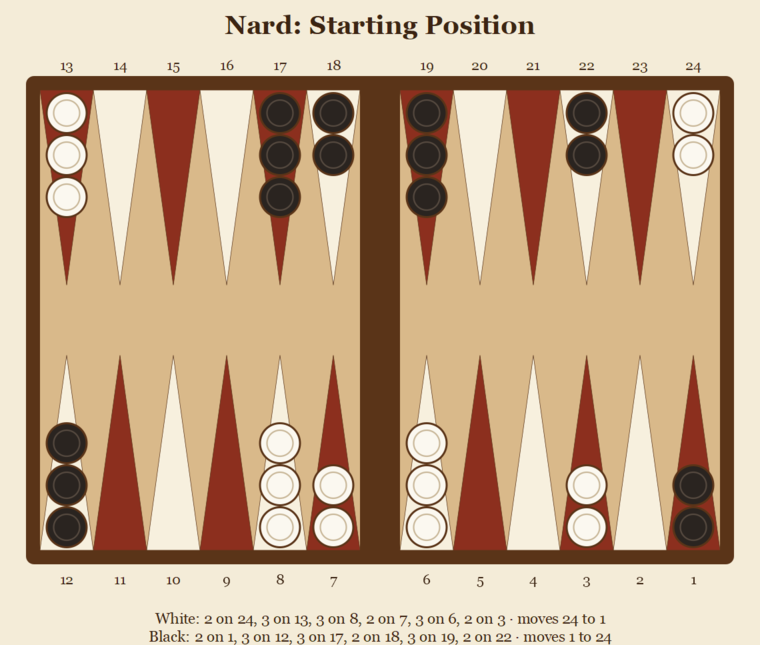
Nard Starting Position
Objective
- Bring all 15 men into your home table and bear them off before your opponent does.
Gameplay
The players move in opposite directions, each towards their own home table.
Throw both dice. The two numbers are separate moves: move two different men, or one man twice, as long as the point in between is open.
Doublets have no special effect. They are played like any other throw.
A point held by two or more of your opponent’s men is closed, and you may not land on it.
A single man on a point can be hit. It is taken off the board and must start its journey again.
A hit man must be re-entered in the quarter where your journey begins (your opponent’s home table), on the point matching one of your dice. You must re-enter all hit men before moving any other man.
Once all 15 of your men have reached your home table, you may bear off, taking off one man for each die from the point that matches it. Your men can still be hit while you are bearing off.
Victory Conditions
- The first player to bear off all 15 men wins.
Optional and House Rules
1. Doublets Twice
- Play doublets twice, as in modern backgammon and Long Nardy, for a faster game.
2. Long Nardy (Modern)
The modern game played in Russia and the Caucasus is very different:
All 15 men start stacked on one point, the head, and both players move the same way round the board.
Only one man may leave the head each turn (except on the first turn).
There is no hitting. You may only move to a point with none of your opponent’s men on it.
You may not build a block of six points in a row unless at least one of your opponent’s men is already past it.
Doublets are played twice. Bearing off all your men before your opponent bears off any scores a double game.
A Note on the Starting Position
The reconstructions of the early rules do not quite agree. Wikipedia gives 3 men on the six-point and 2 on the seven-point, which is the layout used here. Ancientgames.org gives 2 on the six-point and 3 on the seven-point. The other points are the same in both.
Summary Table
| Phase | Action |
|---|---|
| Setup | 3 on your 6 and 8 points, 2 on your 3 and 7 points, 2 on your opponent’s ace point, 3 on their twelve-point. |
| Movement | Two dice, played separately. Doublets count once. Players move in opposite directions. |
| Hitting | Blots can be hit and must re-enter before any other move. Two or more men close a point. |
| Victory | First to bear off all 15 men. |