Irish
Sympkyn of the Moor
Number of players: 2
Type of game: Dice / Tables
Period: 1507 to 17th Century
Irish was the most popular tables game in England and Scotland in the 16th and 17th centuries, and is the direct ancestor of backgammon. It is played with the same board, the same men and very nearly the same starting position as backgammon. The big difference is that in Irish doublets are played only once, rather than twice, which makes it a slower and more careful game.
History of Irish
Earliest Mention: Irish is recorded as early as 1507, when King James IV of Scotland was playing it.
Popular Pastime: A book of 1586, The English Courtier and the Country Gentleman, lists “Irish game, or Dublets” among the pastimes of the time. It was long “esteemed among the best games at Tables”.
The Rules: The earliest full rules come from Francis Willughby’s book of games (written about 1660 to 1677) and Charles Cotton’s The Compleat Gamester (1674).
Backgammon: Cotton says the men are set up as at Irish, and that Backgammon “differs but very little from it, but in Doublets”, which in Backgammon are played fourfold. Faster paced, Backgammon gradually replaced Irish during the 18th century.
The Aftergame: The word aftergame, a comeback plan in Irish, lived on in English as a word for a second chance.
Rules Source: These rules are based on Cotton’s Compleat Gamester and the summary of Willughby and Cotton on Wikipedia.
Rules of Irish
Setup
Board: A standard tables board of 24 points in four quarters of six points each.
Men: Each player has 15 men.
Dice: Two six-sided dice, thrown from a dice box.
Starting Position: Each player places 2 men on their opponent’s ace point, 5 on their opponent’s six-point (in the opponent’s outer table), 3 on their own eight-point, and 5 on their own six-point. This is the same layout as modern backgammon.
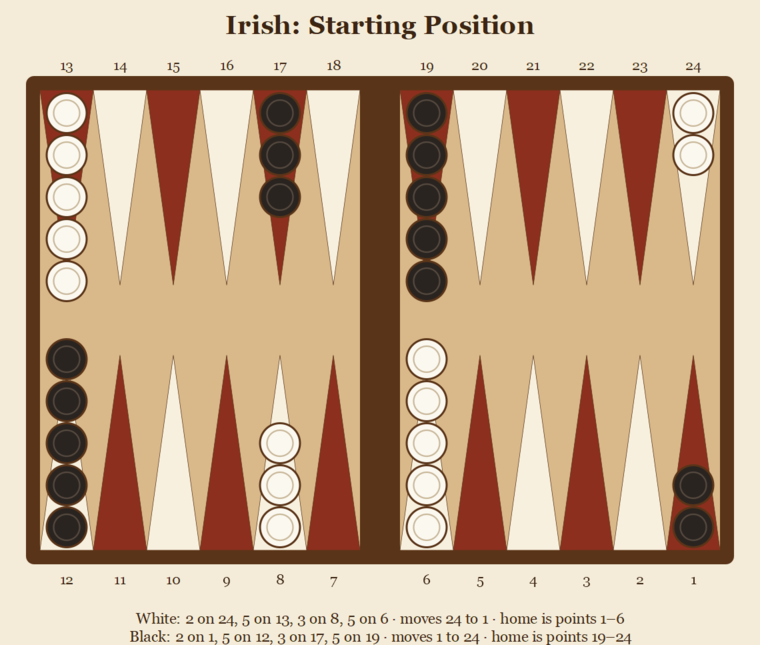
Irish Starting Position
Objective
- Bring all 15 of your men around into your home table and bear them off before your opponent does.
Gameplay
The players move in opposite directions, each towards their own home table.
On your turn, throw both dice. Move one man by each die, or move one man by both. Moving one man by both is called playing at length: the man stops on the point in between, and both that point and the final point must be open.
Doublets are played once, just like any other throw. They do not give a double move.
You may not land on a point held by two or more of your opponent’s men.
A single man on a point is a blot. If your opponent lands on it, it is hit and taken off the board.
A hit man must be entered again in your opponent’s home table, on the point matching one of your dice. You must enter all your hit men before moving any other man.
Once all 15 of your men are in your home table, you may start bearing off.
Victory Conditions
- The first player to bear off all 15 men wins the game.
Strategy
Cotton’s advice for Irish is to play carefully rather than boldly:
Do not hit every blot you can. Move slowly and securely, and bring your men home as safely as you can.
Take special care that your opponent does not double up his men on your trey and ace points.
Fill up your own home table and avoid leaving blots. Then bear off as fast as you can.
The Aftergame: If you throw badly early on and fall far behind, you can change your plan. Leave blots on purpose so that they are hit, then use the returning men to block your opponent’s way home.
Optional and House Rules
1. All Men on the Far Side
- Cotton also gives a second starting position, like Alfonso’s Todas Tablas, where all 15 men start on the opponent’s side of the board: 2 on the opponent’s ace point, 5 on the opponent’s six-point, 3 on the point two further on, and 5 on the opponent’s twelve-point (the far end of their outer table).
2. Backgammon Rules
- Play doublets twice, as in Backgammon. Cotton’s Backgammon also scores a double game for going out with doublets, and more again for a “backgammon”, when the loser is caught badly behind. See Cotton for the details.
Summary Table
| Phase | Action |
|---|---|
| Setup | 2 men on the opponent’s ace point, 5 on their six, 3 on your eight, 5 on your six. |
| Movement | Two dice. Move one man per die, or one man by both. Doublets count once. |
| Hitting | Blots can be hit. Hit men re-enter in the opponent’s home table before any other move. |
| Victory | First to bear off all 15 men. |